

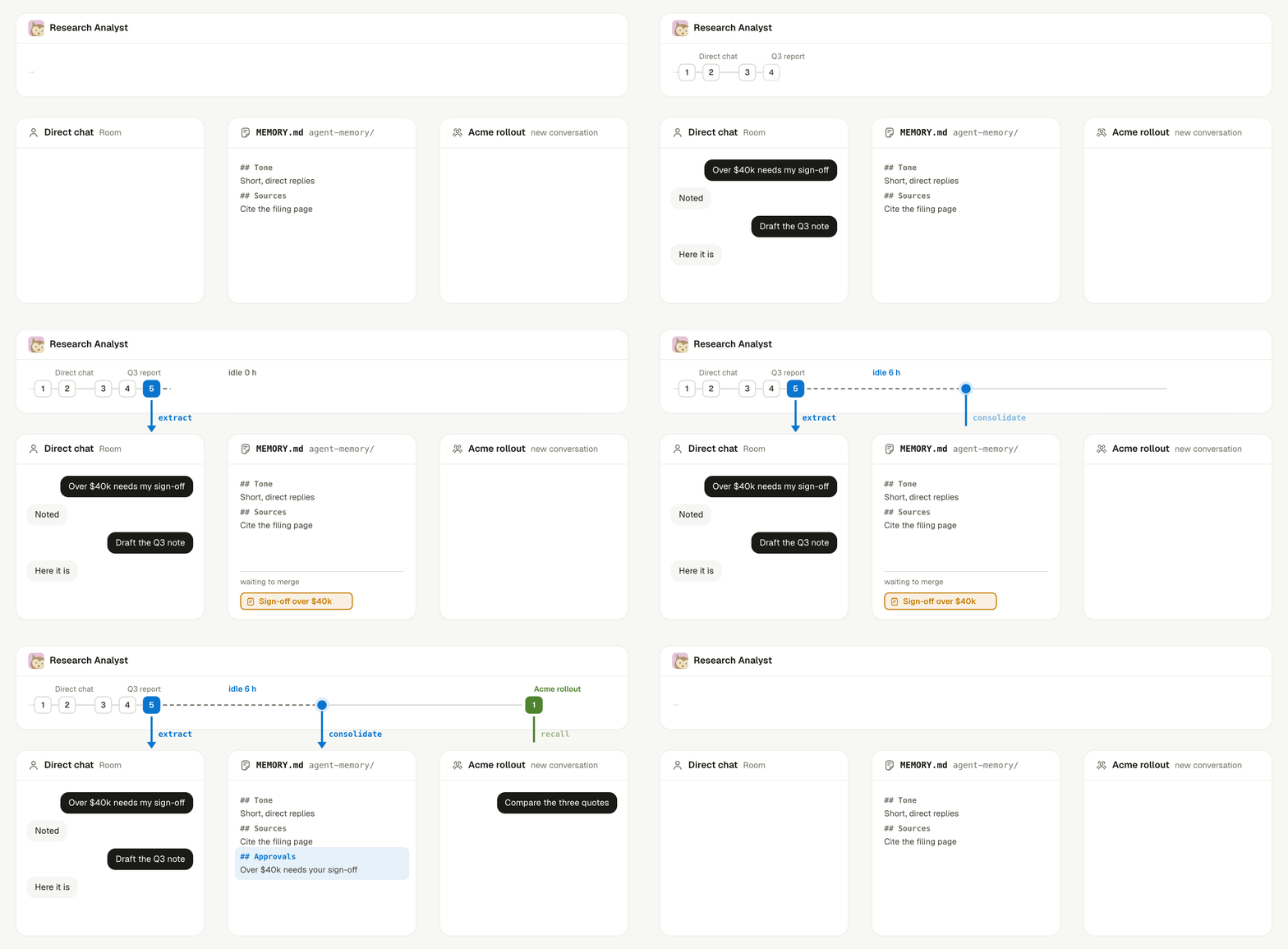
A rule from one Room shapes a reply in another.
How does a lesson reach another Room?
A lesson moves between Rooms in three background steps. The agent never writes its memory during a chat.- Extract. Linger reads the new messages and tool calls in each of the agent’s Rooms. Each Room yields a short session summary and candidate memories.
- Consolidate. The candidates merge into one memory, organized by topic. Only the sections that change are edited. Duplicates and facts that a later conversation disproved are removed.
- Recall. When the agent starts a conversation in any Room, its first message carries a short summary of the memory as a hidden note. The agent reads the full memory when it needs more.
agent-memory/ folder in each workspace of the agent:
summary.md: the short index that the note carries.MEMORY.md: the memory, organized by topic.session_summaries/: one summary per Room.
MEMORY.md. The note never goes into the system prompt, so a memory update does not invalidate the prompt cache or restart the agent.
When does memory update?
Memory updates on its own schedule, not the moment you speak. A lesson reaches other Rooms hours after you teach it.
Extraction waits for five runs because it shares the model with the conversations it reads. Consolidation reads the whole memory, so it waits until the agent is idle.
The schedule shapes what you see:
- A new agent starts empty. Its first memory appears after its fifth successful run and the consolidation that follows. Until then, it has no
agent-memory/folder and no note. - A running conversation keeps its memory. A conversation already under way gets new memory only after Linger compacts it, which happens to an idle Room conversation about every 12 hours. A new conversation gets the latest memory at once.
- Only Room conversations count. A Task’s report to the agent is part of the Room, so it can enter memory. The Task’s own steps and Document work do not, and their runs do not count toward extraction.
- A restart resets the count. When the Linger server restarts, the count of runs toward the next extraction starts again from zero.
How much can memory hold?
The size of memory follows the context window of the agent’s model. An agent on a smaller model keeps a shorter memory.- Each step fits in half the window. One extraction or consolidation uses at most half of the model’s context window. The other half stays free for the Runtime’s own prompt and the answer.
- The memory takes at most half of that. The rest of the step is left for the candidates being merged. When the memory outgrows its share, consolidation shortens or drops its least useful sections.
- Long records are cut. Extraction keeps only the beginning of a very long message or tool result, such as a file or page that a tool returned.
- Session summaries cover recent Rooms. The folder keeps summaries for the 30 Rooms with the most recent activity. An older Room’s summary is dropped after its candidates are merged.
Keep learning
Agents, Rooms, and Contexts
See how one agent works in many Rooms at once.
Personal memory
See what Linger records about your work for every agent.
Memory layers
See how agent memory and the wiki fit together.
Task delegation
Hand long work to background Tasks.