

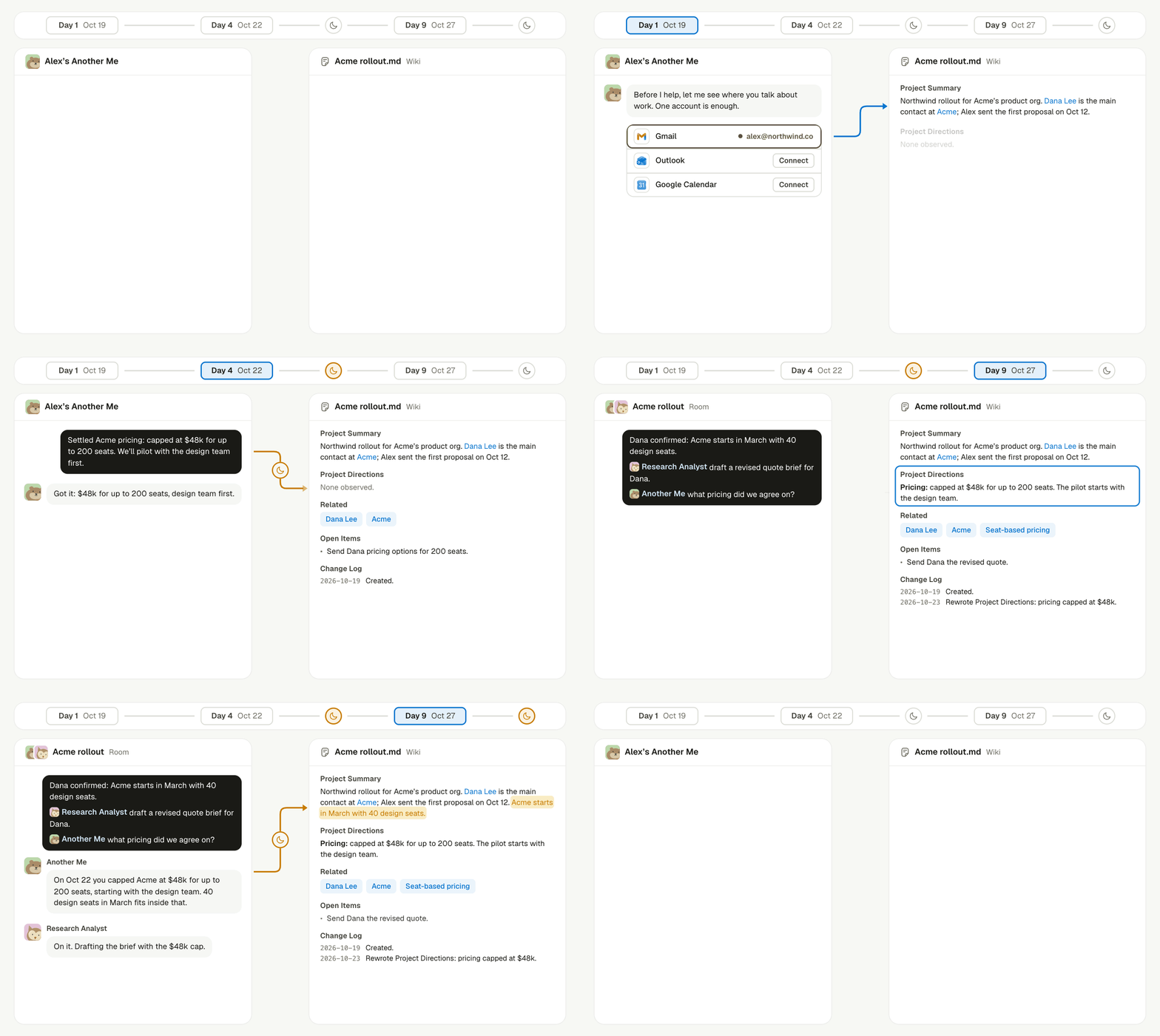
One wiki page grows over nine days.
How do the two levels compare?
The two levels differ in scope, reader, and update schedule. Use this table to tell them apart.How does the personal memory work?
The personal memory gives each real-world entity one page, so every fact has one home. Clients, contacts, projects, and topics each get a page. Each conversation or meeting gets a Session page that links to the entities it touched. When you connect your inbox, Another Me reads back through the last few months to start the wiki. From then on, your conversations flow back in each night. A model proposes changes section by section, and the app checks each change against the page it replaces. The wiki guards its own history:- Sources. Each fact cites the message or file version it came from.
- Lists. A list section changes one entry at a time, so other entries stay exactly as they were.
- Change Log. The app, not the model, writes one dated line for each rewrite, edit, retraction, or merge.
How does agent memory work?
Agent memory crosses Rooms but not agents. What an agent learns in one Room, it can use in the next. No other agent sees it. The agent does not write its memory during a chat. Three stages run in the background:- Extract. After several successful runs, new messages and tool calls become a session summary and candidate memories.
- Consolidate. After the agent has been idle for a while, or when the context is compacted, the candidates merge into the memory. Duplicates and disproven facts are removed.
- Recall. The first message of a new session carries the summary index. The agent reads the rest on demand.
Who does the background work?
Your own computer does the background work for both levels. Each update is a model call, without tools, to the Codex or Claude Code you signed in to. The calls use that account and count against it. Background work waits its turn on every computer. It starts only once your chats have been quiet for a while, one job at a time, so it never slows a conversation. Agent memory runs before the wiki refresh. This queue matters most on a local model, which slows down for every extra request. See Model scheduling.What should you do when a memory is wrong?
What you say now wins. Correct the fact in a chat, in plain words, and the agent uses the correction at once. The stored memory catches up later:- Personal memory. The page is rewritten in the next nightly update, and the Change Log records it. Your correction is searchable sooner, shortly after the conversation goes quiet.
- Agent memory. The next extraction picks up the correction. The next consolidation merges it into the memory.
Keep learning
Personal memory
See how wiki pages are built, searched, and changed.
Agent memory
Learn when an agent’s memory updates and where to find it.
Proactive Another Me
See how Another Me learns rules from your replies.
Where your data lives
Know which machine keeps each level.